Far-Infrared Full-Surface Heating vs Conventional Nichrome Wire Tire Warmers
Two tire warmers can display the same temperature while creating very different conditions inside the tire. Surface temperature alone does not show how evenly heat has reached the tread, carcass, inner surface, bead area and rim.
GET HOT uses far-infrared full-surface heating to distribute energy over a broad area of the tire. A conventional nichrome wire warmer concentrates heat along individual wire-contact lines and relies mainly on thermal conduction from the outer surface toward the inside. The images and temperature data below illustrate why the heating method matters for hot pressure, tire preparation and chassis setup.
Full-Surface Radiation and Line-Based Thermal Conduction
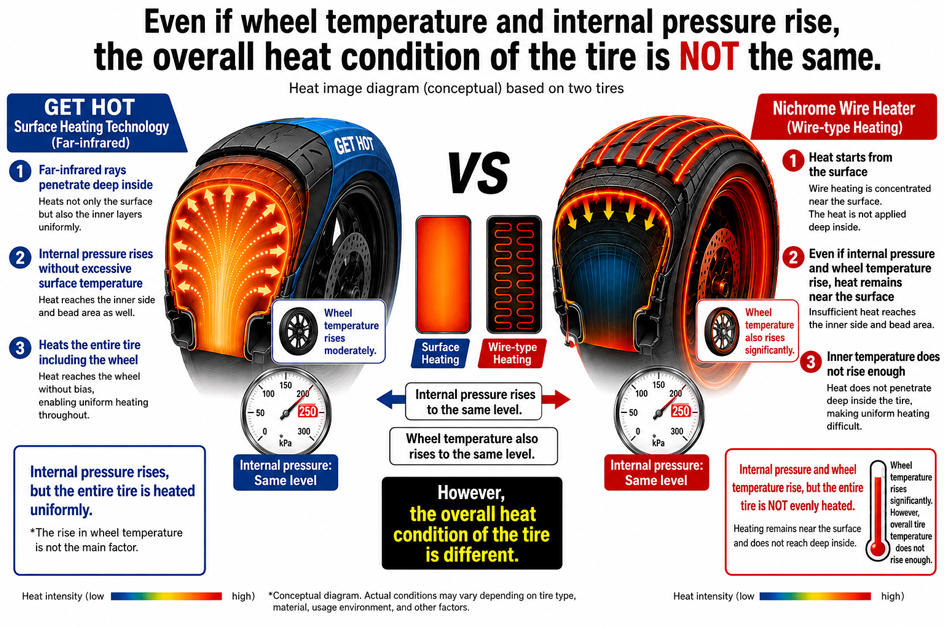
GET HOT radiates far-infrared energy across the tire surface and toward its internal structure, making uniform heating easier to achieve. With wire-type heating, the areas directly touching the wire become hot first. Heat must then travel from those narrow contact lines into the rest of the tire.
This difference can create localized high-temperature areas at the tread while the inner structure remains cooler. A temperature sensor may report that its preset value has been reached even though the complete thermal distribution of the tire is still different.
Thermal Distribution Closer to Actual Riding Conditions
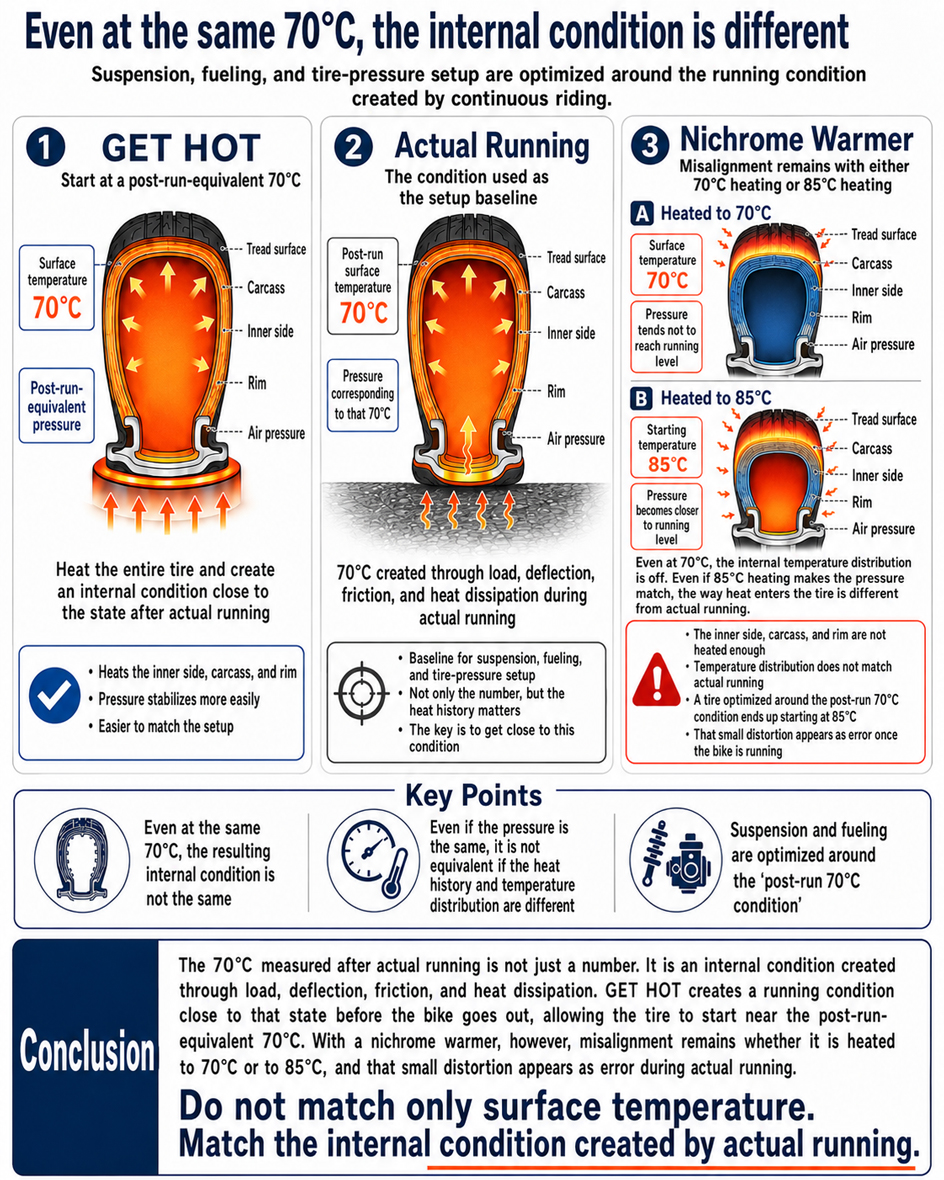
A tire generates and distributes heat during riding through load, deflection, friction and heat dissipation. The goal of tire preparation is therefore not merely to produce a number on the tread surface, but to create an internal thermal condition that is closer to the condition used for suspension, pressure and chassis setup.
GET HOT full-surface heating is designed to spread heat broadly through the tire. Conventional wire heating can leave distinct hot lines near the outer surface and cooler regions deeper inside, creating a thermal distribution that differs from actual running.
The Same Surface Temperature Does Not Mean the Same Tire Condition
A tire measured at 70 degrees Celsius after riding has a heat history created by load, deformation and friction. A tire warmer that heats only the outer surface to the same 70 degrees Celsius may not reproduce that internal condition. Even if additional surface heat raises pressure to the expected value, the distribution through the carcass, inner side and rim can remain different.
For reliable setup work, temperature and pressure should be considered together with how heat is distributed through the tire structure. GET HOT is designed to reduce the gap between pre-heated tire condition and the condition produced during actual running.
Rapid and Uniform Reheating Between Track Sessions
Full-surface heating also helps restore tire temperature after the tire has cooled during urgent trackside work. The thermography sequence compares temperature recovery over 5, 10, 15 and 20 minutes, showing how a broad heating area can support faster and more uniform reheating.
Equal Pressure Does Not Guarantee Equal Internal Heat Distribution
Wheel temperature and internal pressure may rise with either heating method, but those numbers do not prove that the complete tire has been heated uniformly. A surface-biased wire warmer can raise pressure while leaving deeper regions cooler. GET HOT applies energy over the full surface to help heat the inner structure without excessive localized tread temperature.
Localized Heating Can Create Hot Spots and Tire Damage
A conventional thermostat normally measures temperature at the sensor location. It does not directly measure every part of the heating wire or every contact point across the tire. While the sensor is still below its preset value, individual wire-contact areas can become substantially hotter than the measured tire temperature.
This concentration of heat can produce hot spots, uneven tire preparation and, in severe cases, damage to the tire or the warmer fabric. The examples below explain why uniform heat distribution is as important as the displayed temperature.
This tire was damaged by excessive heat from a conventional heating-wire tire warmer.
A heating wire primarily heats the areas where it is in direct contact with the tire. The heat must then transfer from those contact points throughout the entire tire.
You may assume that the built-in thermostat prevents overheating by controlling the temperature. However, the thermostat measures the tire temperature at the sensor location—not the actual temperature of the heating wire itself.
Until the measured tire temperature reaches the preset temperature of 194°F, the heating wire continues to generate heat. During this process, the temperature of the wire may exceed 248°F, creating localized hot spots and potentially damaging the tire.
As a result, a tire can be damaged before the race by the very tire warmer that is supposed to prepare it for optimum performance.
The tire warmer has burned through, exposing the heating wire.
If the temperature of the heating wire itself were properly monitored and controlled, this type of damage would be far less likely to occur.
However, the thermostat measures the temperature of the tire at the sensor location—not the actual temperature of the heating wire. This damage indicates that the heating wire reached an excessively high temperature, causing the surrounding fabric to burn.
Thermal Images Reveal the Difference
The thermal image on the left shows localized hot and cold areas created by line-based heating. The GET HOT image on the right shows a broader and more uniform temperature distribution. This uniformity helps teams begin each session with a more repeatable tire condition.
Temperature Logs and Thermography Comparison
Temperature logs and thermal images provide a clearer view of heating behavior than a single thermostat reading. The records below compare GET HOT with other tire warmers and show how line-contact heating can create visible temperature bands while full-surface heating distributes energy over a broader area.
Click the temperature logs to enlarge them. When comparing systems, evaluate warm-up stability, temperature distribution and the condition of the complete tire rather than relying on one surface measurement.
↑↑↑Click to enlarge↑↑↑
The Heating Method Matters
Prepare the Complete Tire, Not Only the Displayed Temperature
A professional tire warmer should create a repeatable thermal condition that supports hot-pressure control, suspension setup and rider confidence. GET HOT far-infrared full-surface heating is designed to reduce localized hot spots and bring the complete tire closer to the condition produced during actual riding.
Explore the GET HOT product range or contact us with your motorcycle, tire sizes, voltage and racing application.